Sunday, April 29, 2012

The French Connection


The Eiffel Tower from the Trocadero.
In the spirit of TAKS and STARR standardized testing this past week, I took some time off from teaching lessons.  Instead, Samantha and I took advantage of our free time by jumping on an airplane and flying to France to visit my youngest brother Joey.  This was our first time in France, and I do have to admit, I was readily anticipating encountering stereotype after stereotype.  I was pleasantly surprised - the French did not live up to my negative expectations.
As timid Americans, we emerged from our United flight weary and excited, unsure in how well our limited French skills would help but eager to try.  With the help of a very polite airport employee (speaking clear English), we were able to locate the trans-terminal train and find our way to the Gare Charles du Gaul (the train station at the airport).  After fighting with the electronic ticket machine for a little while (it helps to read ALL the directions), we had our tickets in hand and were ready for the four hour train ride to Nantes where we would meet my two brothers.
Waiting to catch our train connection in Le MAns.
Our train ride was our first experience with an unexpected French characteristic - silent trains.  Whether on a cross-country train, a regional commuter train, a local tram, or the Paris metro, French people are uncomfortably silent.  Conversations take place in hushed whispers, leaned in close to the ear.  I am a mumbler - I fit right in.  
We did encounter a stereotype in our train commutes, but not a French one.  The French regard Americans as loud and brash, unaware of their surroundings, who never attempt to meld into the local culture.  Unfortunately, we discovered the truth behind our own stereotype.  While we were not the typical Americans - neither of us are loud people - Americans on the trains might have well been draped in the Stars and Stripes.  They were loud, brash, and even made us uncomfortable with their volume.
Our time in Nantes was characterized by walking tours of the city, enjoying the local food and wine, and enjoying the French people.  Joey, my brother, is wrapping up a year of study in Nantes as a French Studies major.  He was a gracious host, welcoming us into his dorm and cooking for us, acting as translator everywhere we went, and leading us through the sights of Nantes and the surrounding area.
Another French stereotype proved wrong for us both in Nantes and in Paris - the French are polite.  In every encounter, whether in a restaurant or cafe, at a ticket window, on a train, or with the bathroom attendant, French people are pleasant.  Bonjour!  Sil vous plait!  Merci!  Bon soir!  Always ready with a please and thank you, the French welcomed us into their country with open arms.  Even when they knew we were Americans.
Gigantic crepes at The Puss in Boots cafe in Clisson.
French food was tasty.  We had crepes a plenty, galettes smothered in cheese, the traditional croque monsieur, croissants nearly every day.  Freshly baked bread accompanied every meal, and sometimes became the meal.  Cheese was delicious and abundant - we even saw hamburgers served with a thick slice of parmesan reggiano perched delicatly atop the bun.  The vegetables had to have been picked that day, perhaps from a garden just behind the cafe.
The best food we ate the entire trip was on the Rue Cler in Paris.  This little pedestrian street nestled between the Eiffel Tower and the Invalides Museum, where Napoleon’s tomb rests, transforms from a bustling market street during the afternoon into a row of sumptuous cafes after sunset.  The first night we ate at Cafe du Marche and enjoyed traditional french fare - I dined on Confit du Canard (duck fried in its own fat) accompanied with roasted pomme du terre (potatoes - literally apple of the earth), and a green salad.  We accompanied our dishes with a pichet of Burgandy.
The amazing Tomate Mozza
The next night we ate next door at a place owned by the same people.  Tribeca is a traditional French cafe serving Italian food.  We sat a few tables down from some loud Americans and feasted on Tomate Mozza salad, Lasagna Bolognase, and a Parma Ham pizza, accompanied by a pichet of Bousilly Grenache.  Wow!  This was the best food yet.  It was only outdone upon our return to Tribeca the next night.  We began with the same salad, but this time dined on the Penne and a Margherita Pizza.  The wine was so good from the night before we ordered another pichet. 
Just a funny little note - my breakfast of choice in Paris was Pain du Raisin from a boulangerie near our hotel.  The translation is grape bread.  The French don’t have a word differentiating between grape and raisin, so even though I ate raisin bread, it is called grape bread.  Oh, and it is delicious.
Now, we didn’t just ride trains and eat the whole time.  We saw the sites as well.  In Nantes we enjoyed the Chateau du Ducs Bretagne - the castle protecting the region of Britannia from the French Kings during the 1200s.  We saw the Cathedral du Nantes, and were even filmed by an amateur French filmmaker making a film about a spy.  Samantha and I played the role of anonymous spies, sitting in a pew to covertly receive a “package” from the main spy.  We traveled to the small town of Clisson to visit another chateau, this one part of a defensive ring of castles surrounding Nantes.  
In Paris, we climbed the stairs to the second level of the Eiffel Tower, said hello to Napoleon, learned about WWI and WWII, got dirty looks in Chanel on the Champs Elysee, climbed the Arch du Triomphe, wandered the gardens of Versailles in the cold wind and rain, saw where Marie Antoinette escaped from the Parisian mobs, negotiated the maze that is the Louvre, basked in the ethereal light cast by the stained glass windows in both Notre Dame and Saint Chapelle, and ate at the most profitable McDonald’s in the world.
All in all, our trip was fantastic.  Sure, the weather could have been more pleasant (low 40s, windy, rainy), but at least the lines were short everywhere we went and the French BO was kept to a minimum.  The people were beautiful, the food and wine was amazing, and the aura of France was magical.  Thanks France for showing us such a great time and for dispelling some stereotypes in the process.

Sunday, April 15, 2012

Spilling the Beans


Ever feel like this is you?

I have been carrying around a lot of stress recently.  I have piled it up on my shoulders, determined to struggle alone with my burden, not wanting to throw it off on anyone else.  It has pulled my mood down, and instead of keeping a delightful air about myself, I succumb to the sarcastic and slightly negative.  There have been times in my life where I have been stressed worse, and I am sure there are many of you out there thinking “buddy you don’t know what stress is,” but for some reason, this particular bout of stress seemed to carry a little more weight than it should have.
Stress shares characteristics with the physical properties of pressure dynamics.  Imagine a closed pressure chamber in which exists air contained at the pressure equal to outside the chamber.  Now, by adding more air into the chamber, the pressure increases.  As more and more air continues to enter the chamber, the pressure climbs higher and higher.  Internally, the environment is gradually becoming more hostile.  As the pressure climbs, so does temperature.  The air becomes thicker as more and more molecules are forced to exist in the same space.  The walls of the chamber are designed to withstand a particular amount of internal force, but when the pressure exceeds that amount - BOOM!  The chamber blows.
We are all pressure chambers, but instead of our pressure regulators measuring the amount of air pressure within us, they would should stress.  For the most part, we exist with stress well below what we can handle, but periodically, as more stress barges into our lives, our stress chamber becomes more full, increasing our internal pressure.  The more stress we have, the higher that internal pressure becomes, and unless we find a release for the stress, the results will not be good.  If release never happens, our temperature will rise, and eventually, we will blow.
This particular stress episode of mine stemmed from feeling overwhelmed at the variety of my responsibilities.  I felt like I wasn’t able to fully accomplish anything I set out to do because of all the other things looking over my shoulder.  If I took a moment to relax, I felt guilty because there was a pile of work I needed to do in my office.  If I took a second to work on a personal project, my professional work grumbled.  While I worked on teaching schedules, I couldn’t help but feel that I was neglecting the activities that lead to a happier life.  It never seemed to stop.  My pressure was building.
The image I have in my mind of what happens when a person reaches their stress point took root way back in the 80s when I was growing up.  One of my favorite childhood movies - The Ghostbusters - reaches the pinnacle of tension at the end of the second act when they are forced to shut down the containment grid.  Those of you who have seen the movie know the exact scene I am referring to.  Vankman and Egon slowly creep away as the order is given to shut it down - they know what is about to occur.  The lever is thrown, a red light flashes and an alarm sounds.  Steam shoots out from the walls.  Bricks fly.  The walls shake.  Then everyone runs.  The grid blows, unable to handle the pressure inside, and from it spews every ghost, ghoul, and demon the Ghostbusters had been able to catch.
This is what it is like when someone blows.
We each have varying degrees of containment grids.  Some of us can withstand quite a bit of stress, while others can barely take any at all.  I am pretty certain we each understand our individual limits, but I am not sure we are all certain of how to find a release of that internal stress pressure before we blow.
For me this week, my release came from simply having a conversation with Samantha about it.  For weeks, I succumbed to the stupid masculine idea that I was strong enough and didn’t need to burden her with my worries.  All I succeeded in doing was to give her the impression I was in a funk - which was true.  Finally, I admitted to her what all was bothering me.  I spilled the beans.  While I spoke, I could feel the stress leaking out of me.  The next morning I felt so much better.  The stress was still there, but it was manageable.
I forgot that just because my stress burdens me, it won’t necessarily burden other people.  Talking about my worries to Samantha didn’t add to any worries she might have, but it relieved the pressure I was feeling on the inside.  I will not be blowing anytime soon.
There are many stress relievers out there to help you manage your stress levels.  Just the first page of a Google search for “stress reducers” produces this hearty list of choices - humor, diet, exercise, sleep, music, thinking positively, deep breaths, getting up early, play ahead, writing things down, changing it up, patience, simplify, don’t worry, organize, add love into the plan, be flexible, delegate, don’t judge, journal, water, kissing your loved one, cuddling, tea, massage, and sex.  There are many to choose from that can fit all lifestyles.
If you are stressing right now, find something to help let off some of the steam.  Maintaining a positive balance takes concentration and focus, but the results are worth it.  For those times when the stress seems to pile up, just remember what will happen if you don’t let it out.  Think the Ghostbusters. 

Sunday, April 8, 2012

Finding Your Gethsemane


One of the most vivid dreams I have ever had occurred over ten years ago, when I was in college.  In the years since, the dream has stuck with me, constantly encouraging me to keep the right perspective through every decision, no matter big or small.  The most significant factor in giving this dream the influence over my life that it has?  I died.
Today is Easter; billions of Christians the world over are celebrating the Resurrected Christ, who, according to the Bible overcame death and sin through personal sacrifice.  For Christians, the act of Christ’s submission to God’s will as the sacrificial lamb has and always will be the centerpiece of their faith.  Through Christ’s voluntary death, sin no longer has a hold on a Christian’s soul.
While many people focus on the most harrowing portion of the Passion story - the trial, the scourging and mock coronation, the long, burdened walk to Golgotha, the crucifixion and Christ’s release, and ultimately the resurrection - as the most significant portion of the story, I do not.  Though diminutive compared to the scope of other stories, Gethsemane is the most profound story of the Bible.
My dream, all those years ago, reflects the message found in Gethsemane.  While I don’t recall all the specifics, the generalities are clear.  I am in a large city and within the city is a nuclear bomb.  Detonation is immanent.  My job is to ensure everyone is clear from the blast area, and at the time of my dream I am sure that everyone has been saved.  Except me.
As Christ knelt in the Garden of Gethsemane, at the foot of the Mount of Olives, alone amongst his sleeping brethren, the weight of circumstance bore down upon him.  The silence stretched on as he prayed, searching for solace and comfort.  He knew what must be done, but accepting it and moving forward did not come easily.
As I raced through the city, empty except me, I struggled with what to do next.  I knew there was no time to escape the blast radius, yet my will to survive refused to give up, and so I continued in my attempts to discover a way to escape the surety of my death.
Eventually, both in my dream and in the Christ narrative, resolution arrived.  I came to terms with my certain death, and, in fact, found comfort in my resolve.  I knew the only recourse available was to ensure my death was as painless as possible.  Christ, suffering alone, found peace in working the will of God.  He confronted the facts of his situation, acknowledged the reality of his circumstances, and found a place within himself where he knew the significance of his death mattered more than physical suffering and death.  This acceptance propelled Christ into the next series of events, leading to his death and resurrection, and eventually, the Christian belief in Salvation.
Gethsemane contains the power behind the Easter message.  Yes, the Bible tells Christians that the suffering, death, and resurrection releases them from the grip of sin, but without Christ’s powerful contemplation and eventual acceptance of God’s will, the rest of it would have never occurred.
In my own dream, I found comfort in the knowledge that my life was forfeit in order to save the lives of others.  My Gethsemane moment occurred after the completion of my job.  In the mad scramble to escape the city, I came to terms with my death and embraced it.  I raced towards the bomb instead of away from it, and upon entering the room that contained my death, I felt impossible peace that seemed to stretch on forever.   In the next moment, the bomb clicked.  My dream went white and the peace I felt a moment before became fortified with an immense love.  The burden of my death felt so insignificant compared to the enormity of that feeling.  I woke, sobbing at the profound feeling of joy bestowed upon me by my dream. 
I imagine, despite the horror between Christ’s acceptance and his death, that my dream shares similarities with what he might have experienced.  
Since the dream, I hold the feelings I experienced as close to my heart as I can.  Though I have never had the opportunity to experience such a challenging trial in my waking life as finding comfort and acceptance with the immediacy of my death, I seek to employ the same lessons I found in my dream with everyday decisions.  At any junction, acceptance with the results and possibilities following the made decision is vital.  Without it, peace in life remains beyond my grasp.
If you are a Christian celebrating the Easter resurrection today, remember Christ’s decision.  Remember the last lesson he offered to the world before he allowed himself to be carried away on the current of destiny.  Though your life moves forward with the comfort of eternal peace upon your death, remember that Christ shows you how to find peace every day before then.  He shows you how to find your own Gethsemane.

Sunday, April 1, 2012

Reserving Judgement


Trayvon Martin.  George Zimmerman.  Right now, these two names cause more turmoil throughout our nation than any others.  Their simple mention spurs discussions and arguments full of anger, resentment, and outright hate.  The entire situation boils down to one simple, common, and extremely dangerous concept - prejudice.


More often than not, the word prejudice conjures ideas of racial profiling, but the definition of the word is not exclusive to skin color.  We practice prejudice constantly, making decisions about people without the slightest bit of information.  I am sitting in a Starbucks writing this, and every time someone walks in the door, I form an opinion about that person based on what I see.  I am pre-judging them.

  1. A family just walked in.  I see they are well dressed, their clothes appear to be taken care of.  I assume they have money.
  2. Some young men walk in.  Their faces sport beards and glasses, their hair is mussed in a controlled fashion, anchored by product.  Earrings decorate their lobes.  Their dress is casual, but hip - faded jeans and t-shirt for one, untucked button down with a tie over dark jeans for the other.  My first impression is Indie rocker types.  Being that it is Sunday and churches are nearby, my assumption is praise band members.
  3. Two middle-age men come in wearing comfortable clothes, and short hair.  The act important, look meaty, but in that swollen, I-haven’t-worked-out-in-a-couple-years way.  Their gestures are large, they speak in loud voices.  My assumption is former high school or college athletes who are now involved in sales.

While none of these first impressions will affect my life or theirs, the fact that I have prejudice for these people is still real.  My opinions were formed without information and were based solely on how they looked and how they acted during my brief encounter.  My assumptions are based on my experiences, which have nothing to do with the truth.  If I encountered them in the future, my prejudice would inform they way I deal with them.
These kind of prejudices create the unfortunate and sad situation in Sanford, Florida.  

In the first instance, the events leading up to the encounter between George Zimmerman and Trayvon Martin were rooted in prejudice.  But, without any further knowledge of George Zimmerman’s mindset, the only prejudice we can assume is that, as a member of the neighborhood watch, Zimmerman was fundamentally prejudiced against unfamiliar individuals walking his block after dark.  On the evening of February 26, Mr. Zimmerman’s duty was to keep an eye on the neighborhood and inform the authorities of any potential wrong doing.  He did that.  It was his choice to follow Martin, instead of letting the police handle the situation, that lead to the shooting.
The second instance of prejudice surrounding the situation is rooted in the hearts of the rest of us.  From the moment the story blew up on social media, the news crews, newspapers, and talking heads have all pushed the public in thousands of different directions.  We have heard that Trayvon was an angel, a druggie, a violent kid, a gentle, respectful young man.  We have heard that George Zimmerman is a racist, a good wholesome man, or a violent individual.  It is hard to put the pieces together, and the media, eager for ratings, certainly tries hard to do it for us.
Keeping ourselves un-prejudiced towards someone or a situation is hard.  With the barrage of media reports from opposing camps, the ramped up rhetoric from social organizations, the explosion of social media opinions, it is no wonder George Zimmerman has gone into hiding.  This kind of un-informed prejudice leads to mob mentality.  Someone will go too far, and instead of one dead young man, we could end up with two.  We can only hope no one decides to take justice into their own hands.
Prejudice is dangerous on a more personal level as well.  As a teacher, I know I practiced prejudice towards students on campus.  I made assumptions based on how a student dressed, or who a student was with.  I lumped them into groups, which is unfair to the student, who has to dig their way out of the pit into which I have thrown them.  It is also unfair to me, as I haven't given myself a chance to develop an accurately informed opinion.


We can work to limit prejudice in our own lives.  Don’t make up your mind about someone until you know about them.  If you have deep seated prejudice already, give those individuals or that group the opportunity to prove you wrong.  You may be surprised at how often you are.

Sunday, March 25, 2012

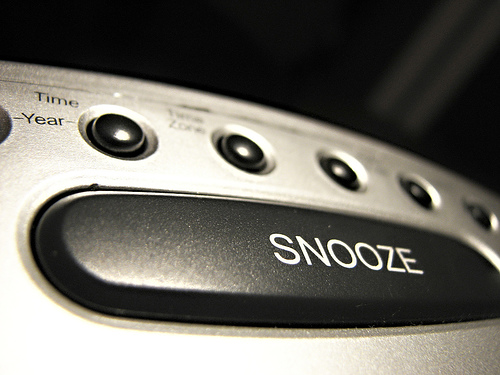
The Snooze Button


For as long as I can remember, I have been in the midst of a winner-take-all struggle with my alarm clock.  Every night, when I reset my alarm for the next day, I vow not to allow the fourteen year old clock-radio to win.  I look into its oversized face, daring the glaring red letters to tempt me into hitting snooze again.  Sure, at night I am bold and resilient, ready to resist the temptation of six more minutes of sleep, but, when morning arrives, my hand acts of its own accord, bridging the yawning void between my nightstand and bed, drawn like a buzzing bee to the freshly opened flowers of spring.  It hits snooze, and I slip fitfully back into the kind of slight sleep which brings no true rest.
Unfortunately, this is my daily battle.  It seems like the only time I ever win this one is when my wake up time is earlier than 5am (which is extremely rare), or when I circumvent the alarm completely and choose to wake up when I wake up (this is rare as well).  So, instead of keeping my head up high, strong in the knowledge I determine my own destiny, I trod along, burdened by the fetters slapped on every morning by my snooze button.
Sure, the snooze button appears harmless.  After all, I have managed to adapt my lifestyle and morning routine to accommodate its unwanted gifts.  What is six minutes here, six minutes there?  Six minutes tend to add up.  The most frustrating aspect of my dilemma stems from two bits of knowledge I frequently use to beat myself over the head.  
First, I never feel more rested after hitting the snooze button multiple times.  Does six minutes really make a difference in my day?  Does twelve?  The answer is no.  Most mornings, I actually feel more rested the first time my alarm goes off.  After I hit snooze a couple of times before I emerge from my warm, fluffy cocoon, my body feels like I ran a marathon the day before and then went on a ten hour bender, mixing every possible liquor before slumping my way into the sack, exhausted and near death.  Does it change anything?  Never.  I still succumb to the intermittent siren call of my alarm.  Beep-beep.  Beep-beep.  Hit-snooze.  Hit-snooze.
Second, I miss out on the things I would prefer to do in the morning before I start my day out in the world.  I know my writing productivity would blossom if I would just get up on time.  I also enjoy a freshly cooked breakfast, and while I don’t despise a microwaved oatmeal or a bowl of granola, when compared with three eggs over-easy accompanied by crisp bacon and some breakfast potatoes, the easy, quick option quickly loses its luster.
How much time have you lost?
Think about it.  If you are a snooze addict like me, consider the time you spend in bed, barely sleeping, wasting away your day, all because of this vile button.  Think back on last week.  How many times did you hit snooze each day?  Two?  Three?  I think I hit snooze an average of three times a day - eighteen minutes.  I did that five days last week.  I lost an hour and a half of my life to the snooze button last week alone.  Now multiply that out over your entire life.  In the last year, I have lost more than three complete days to the snooze button.
For me, the idea of hitting snooze extrapolates out into the rest of life.  Hitting the snooze button is simply a way to avoid moving forward into your day.  By granting ourselves six more minutes each time we give our alarm a soft pat, we delay the beginning of the daily journey.  We drift back into our dreams for a few minutes more and push reality back.  
But, reality is where our dreams come true.
How many of us hit the snooze button in our waking life?  When the universe triggers an alarm, urging you to take a step forward to seize your dreams, do you do it?  Or do you hit the snooze button?
Instead of allowing ourselves a few more minutes of dreaming like we do in the morning, our waking snooze button pushes our true dreams further away.  Dreaming about your future can be daunting, and I understand not wanting to take the first step towards making your dreams come true, but every moment wasted by not pursuing our dreams only increases the possibility they will never come true.
Do you want to live your life trapped in the mediocre purgatory of snooze inspired drowsing, or do you want to wake up when called, taking the leap and emerging fully awake into the possibilities your life has to offer?  Do you want your life experience shortened six little minutes at a time, or do you want to give yourself the gift or more life every day?
I think, when put plainly, the answer is simple.  Now, all you have to do is get out of bed and start dreaming.

Sunday, March 18, 2012

The Best Time of the Year


The best time of the year has arrived here in Houston - spring time.  Our coastal city has shrugged off the vestiges of winter, welcoming the green accouterments common to this portion of the seasonal cycle.  Our fields explode with color, the bare skeletons of trees are once again filled in with verdant life, and birds sing invitations to emerge from our hovels to enjoy the renewed earth.
Spring began early this year, if a little fitfully (as I referenced a couple of months ago in a political leaning post Wildflowers, Flip-Flops, and the GOP).  Warm weather briefly pushed through the mild winter, thoroughly confusing the circadian rhythms found in our ecosystem.  Some trees budded early, wildflowers burst from the soil with a fervor typically reserved for March and April, warm-weather clothing made an escape from the backs of drawers.  For a while, we seemed to have a battle between seasons - a week of winter here, a week of spring there - and neither could seem to overcome the other.  
Until now.
Appropriately enough, Spring Break 2012 heralded the true coming of Spring 2012.  The warm weather was ushered in with an outpouring of rain, adding to our particularly wet year.  Though we still fly towards the Vernal Equinox, the calendar beginning of the spring season, our climate is already there.
Spring time for me is a time for shorts and flip-flops, a time to put away the coats, sweaters, and scarves.  It is a time of warm sun and cool breezes, of sitting on the patio and enjoying a beverage or two.  It is a time of balance.
Spring time also brings birds to the limbs of trees, singing songs of the earth’s beauty.  Slow bees buzz amongst the flowers, collecting and distributing pollen to ensure next year’s spring time floral explosion.  Green pushes through muddled brown bark as fresh new growth stretches towards the sun.
While I usually do some precursor work in my flowerbeds and yard in February - pruning the roses and crepe myrtles, fertilizing the yard - most of my work is done during Spring Break.  On Wednesday, after the rain settled down, I finally got into the yard for some good, hard work.  I dug holes and filled them with plants, removed overgrown bushes and weeds, dead-headed the roses, excavated a failed drainage project, built a base for my sinking outdoor storage cabinet, and cleared out winter junk from the flower beds.  I finished my day happy, stinky, and sporting a red shade on my shoulders a lobster would be proud of.
Despite the burning pain, I loved every minute of it.  I worked again on Friday and Samantha joined in with me Saturday.  Now my yard is just about finished, needing only a few more bags of mulch and a little bit of top soil.
Now, I get to relax and enjoy the fruits of my labors.  As we delve further into the seasonal cycle, I hope that spring will fend off summer as long as it can, maintaining the beautiful feeling the combination of springtime delights delivers to my joyful heart.  If not, and the heat of summer comes when called, I am certain to find a slew of summer characteristics in which I can find a similar joy.


Sunday, March 11, 2012

Untethered


The other night, I was talking to Samantha on my cell.  I was at home relaxing and she was on her way back from a Mary Kay appointment.  We usually call each other when we are on our way home, beginning our time together a little earlier.  Yeah, I know, it’s sweet.  Anyway, nature called, so I got up from the couch and headed to the bathroom.  I tucked the phone between my ear and my shoulder, leaned over and lifted the lid and seat on the toilet.  The next thing I know - KERPLUNK!  My phone slipped from its cradle and gravity did the rest, aiming my phone straight at the toilet bowl.
I snatched the phone from the bowl, grabbed a towel, and dashed for the kitchen, wiping as I went.  I ripped open the pantry door, grabbed a zip-lock sandwich bag, and snatched an open bag of jasmine rice from the shelf.  The outside now dry, my phone went into the bag, followed by as much of the rice as would fit.  I only hoped everything I had read on the internet about using rice to save a phone from an unfortunate encounter with water would work.
With my phone now buried in a bag of rice, I immediately felt gratitude I hadn’t yet started to pee before my phone took its swan dive.  That might have been a mess rice couldn’t have solved.
Now, a few days later, I am happy to report that my phone still holds a charge, makes all the necessary sounds, reacts to swipes on the screen, and appears dry.  Unfortunately, I can’t see anything on the screen.  It has managed to not run out of a charge even though the last time it was plugged in was two days ago.  It remains sequestered in a bag of rice on my kitchen counter.
So, since Thursday night, I have been phoneless, unconnected, and untethered to the world.
In this age of instant connectability, living life without a cell phone has been odd.  When I went to teach Friday, I told Samantha I would call her to meet for lunch.  She asked if I even knew her phone number.  I am happy to report that after ten years, I confidently have it memorized.  But, I am not sure I have many others memorized.  I tried to recall friends’ numbers, family numbers, and other important numbers.  I got nothing.  I know mine, Samantha’s, 911, and a smattering of useless numbers from my pre-cell phone childhood.  Awesome, huh.
The next trouble I encountered was red lights.  I hadn’t realized how much I depended on my iPhone to get me through the red lights I encounter during my day.  I don’t use my phone while driving, except for directions or to talk.  When stopped though, the story changes.  I think I read most of Stephen King’s latest thriller 11/22/63 at stop lights through my Kindle app.  I check the weather, as if I need digital confirmation for what I can see right outside my car window.  I check my email.  I text.  I pay bills, reload my starbucks card, learn french.
Now that I don’t have my phone, what the hell am I supposed to do with red lights?
I can look at the wildflowers outside my window.  I can acknowledge the other people around me (if they weren’t all on their cell phones).  I can look up at the sky and experience the beauty of the planet on which we live.  I can take a moment and let my mind be still.
In a way, I find it slightly ironic, and a bit pleasing, that this happened at the beginning of Spring Break.  I get a vacation from my normal weekly life and at the same time, I get a vacation from my digital shackles.  I appreciate being unavailable.  I can only be reached if I want to be reached.  I am free to sit here, writing my blog, without the distraction of text messages, facebook notifications, myfitnesspal bothering me about entering my breakfast, or any other distractions my phone thinks up.  It is nice.
Try it.  Try a day or two without your phone.  Let people know you are disconnecting so they don’t worry - because they will.  You know they will.  Then put the phone away.  Turn it off.  Open yourself to the world out there.  
Just don’t go about it the way I did.  Water and phones don’t mix.  Let’s hope the rice works.