Showing posts with label think. Show all posts

Sunday, February 3, 2013

Paralysis of Analysis


I have a student who probably should have made region band this year.  Honestly, there is no probably about it.  Had he guided his practice efforts the right way, he would have made region band.  Unfortunately, he succumbed to his insecurities in a way most of us would find familiar.  He couldn’t ever get out of his own head.

Probably three-quarters of the work my students need to do lies in personal perception and how that guides their practice and performance.  Fundamentally, most bassoon students, if placed correctly, are highly intelligent, strongly independent young people.  If prepared the correct way from the moment they first begin to learn their craft, they would all experience high levels of success.  Unfortunately, from the first time they touch the instrument, they experience instruction aimed primarily at correcting mistakes.    For many students, their early instruction teaches them to ferret out errors.  While this may seem like the best way to focus practice, these students have learned to do it to a fault.

The student I mentioned above suffers from this problem.  We can hardly make it through a measure or two before he stops to point out his errors.  He constantly stops, describing the mistake, reasoning out the origin of the error, before restarting.  Left to his own devices, we would never make it past the first line of anything in our lessons.  I am certain his practice sessions proceed the same way.  He is plagued with paralysis of analysis.

My job in his lessons is to deflect his focus from errors.  I work in small chunks of music; any time he stops, I instantly redirect - “keep playing, keep playing, keep playing” - until he resumes.  I don’t let him offer a single unobstructed comment until he has completed the chunk.  Once he achieves that, we dissect the phrase, find the errors, prescribe a solution, and work through it again - without stopping.  Slowly, I am teaching him to practice the right way.  He will make region next year.


Most of us succumb to the same sort of paralysis at points in our life.  We over-think to the point of negativity, sometimes thinking long past the point when decisions should be made.  Often, we wait so long, decision making slips from our skill set, leaving us bereft of the ability to even decide something as simple as what to eat.  

This paralysis resides in fear.  My student fears someone will catch him unaware of his own mistakes, so he stops constantly to point them out when playing on his own.  When playing in band class, the fear retreats - the likeliness of getting caught making mistakes reduces substantially when playing with sixty or seventy other musicians.  If we looked deep within ourselves, our insecurities develop from similar fears.  Our society prides itself on perfection.  We learn from an early age mistakes are frowned upon, so we prevent them by avoiding activities in which they occur or we jump the gun and point them all out unnecessarily.  Neither are the solution.

Makemisteaks_monsieurcabinet-480x679
I teach my students that mistakes lead to growth.  We are human; we err.  I tell them to give themselves permission to make mistakes.  Allowing themselves to err reduces the power a mistake has over their psyche.  Eventually, they roll right past their mistake unaffected.  Now, to be clear, I stress the difference between ignoring a mistake and moving past a mistake.  One is healthy, the other is not.  We practice with a “mistake basket” in which they deposit their mistakes while playing a particular passage.  After they complete the passage, we examine the basket’s contents and decide which items need our focus.  Eventually, we free ourselves from the paralysis of analysis.

Mistakes are necessary for growth, for developing character.  Learning how to handle mistakes in our lives positions us to roll with anything the world might throw our way.  Avoiding or over indulging them does not offer a solution to the problem, rather it roots the problem deeper.  Avoid the paralysis of analysis before it sets in too deep.

Sunday, June 24, 2012

Getting Burned


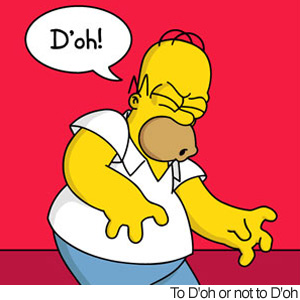
Every so often we do dumb things.  Most of us commonly share the Homer Simpson experience of slapping our forehead and saying “Doh!” because of some silly, simple error.  Most often, these moments are preceded by an uncalculated, rash act.  This is what happened to me today.
If you are a relatively new reader, you might not know that I like to ride a road bike.  Lately my schedule has only allowed me weekend forays on the bike and I usually keep my rides to an hour or so.  Personally, I love the feeling of flying down the road, in and amongst nature, with the warmth of the sun and the cool breeze playing counterpoint to each other.  
My normal ride takes me out of my neighborhood, down a slightly busy street, and into Bender’s Landing, a nearby burb whose wooded half and full acre plots sport a variety of architectural styles ranging from glorified row house to neo-mid-century suburban castle, from transplanted ski lodge to Mississippi plantation.  I love looking at the eclectic mix of homes as I press myself to push my pace, streaking by man-made lakes mixed with virginal nature.  The roads are well maintained and nearly traffic free, the trees provide shade without blocking the breeze, and the options for longer rides are plentiful with just an easy right or left turn.
In my nearly three years of riding, luck rides with me - I have never been injured.  Until today.  Now, there are many ways a bike injury occurs.  Collision with another object - animate or inanimate.  A surprise wind gust throwing off your balance.  An unfortunately placed speed bump.
My injury was none of these.  Most injuries occur as a result of something unforeseen.  Mine could have very easily been prevented had I just thought out my actions.
I had just left my neighborhood and was traversing Riley-Fuzzel Rd. (soon to be the Grand Parkway).  The two lanes of traffic each way are easily escapable thanks to a wide paved shoulder.  Frequently, to a cyclists chagrin, the shoulder becomes the repository for road waste - tire bits, broken taillights, periodic trash (Don’t Mess With Texas!), and broken glass.  I usually do well to avoid to obstacles, keeping my eyes ahead, but today I rode through a pocket of broken glass.
One of the first lessons I learned while riding the bike is to keep the tires free of broken class - duh, right - so I did what you are supposed to do.  I leaned forward and, using the portion of my glove between my thumb and forefinger, pressed against the front tire, clearing the tire of debris.  Then, I reached behind me, just under the saddle, and did the same thing.
Now, those of you who ride bikes, or understand the basic laws of physics, know that when you ride a bike, the tire rotates.  When something touches a rotating object, frequently, it is influenced by the velocity of the rotation, pulling it along.  Touching a rotating bike tire is no different.  When clearing the front tire, I did what I was supposed to do - I pressed my glove against it just past the prongs, making sure my hand was pulled away from them.  On the back, because I didn’t think, I just acted, I touched behind the prongs.  In a fantastical display of the laws of physics, the tire pulled my hand along with it, cramming it into the gap between the tire and the back prong.  Of course, I was still moving (and in fact pedaling), meaning the tire kept moving in the same direction, despite my hand being in the way.  Finally, after the surprise ripped away, I yanked my hand out and continued my ride.
My glove protected most of my right hand, but I still managed to tear the skin off in a couple of places and give myself friction burns on others.  For a musician, it could have been much worse.
Make sure to think before you act.  It doesn’t matter if you are riding a bike, in the middle of an emotionally charged argument, or pursuing a like changing decision, always give consideration to the results of your actions.  I learned an important lesson today (one I am certain I have been taught before), but I know, had it been any number of other situations, the results could have been much more dire.  Take it from me: don’t get burned.