Sunday, February 24, 2013

Growing Musicians


http://cl.jroo.me/z3/k/B/8/d/a.baa-Musical-plant.jpg
I love this time of year.  Region Band auditions are over.  Solo and Ensemble is over.  Band Auditions and Benchmarks are still somewhere over the horizon.  The possibilities are endless.  This is the time of year I can once again mold my students into powerful musicians and not just chasers of notes and rhythms.  And it is Spring (well, maybe not officially yet, but Punxsutawney Phil did say it would be early this year).

The competitive focus in my bassoon and saxophone studio thrums with intensity during the fall.  Focus on region etudes and scales drives most practice sessions, many times stifling technical and musical growth because of the kids’ one-track focus .  Lessons attempt to balance fundamental musicianship with cramming notes and rhythms.  All in all, the fall is hyper-intensive, super-focused, and driven.  It wrings me out like a sponge - hearing the same music every day eventually begs questions of sanity.

http://www.the-ridges.net/images/bare_trees.jpgAt the same time, the local foliage goes through a transition into dormancy - much like my students’ musical development.  With a fiery burst, trees abandon their leaves, littering the ground with the past year’s greenery.  We are left with bare branches and skeletal woodlands.

Winter arrives.  Again, my students have a singular focus - solo contest.  While their efforts are more individual, their pieces catered to their own specific skill level, and I regain a measure of sanity from the variety of music, the students still have a short period of time in which to learn a complex piece of music.  Their attention has a little more flexibility, and just like in the fall, lessons work to balance good musical skills along with the solos, but they still prefer the solo to fundamental practice.

http://carolwingert.typepad.com/be_yourself_live_with_pas/images/spring_buds.jpgNow, Spring approaches.  The Spring season is my favorite and write I about it every year.  I love the newness in the air, the fresh balance of a chilly morning and a warm afternoon.  I can’t wait to get outside and plunge my hands into the soil, to take winter’s leavings and craft them into something extraordinary.  I look forward to the explosive emergence of greens, reds, blues, yellows, and every other imaginable hue and shade this beautiful planet offers.

In the same way that the planet emerges from the slumber of winter dormancy and explodes in growth and life, so do my students.  Now that individual competition sits behind us for the moment, I relish the opportunity to develop the personal strengths of each student, to tackle individual weaknesses, to foster a strong understanding of music theory and how to apply that knowledge to creating a beautiful phrase.  I cherish this time of year because I get to grow musicians.

http://www.wallpapersbuzz.com/image/649/b_plantation-of-spring-flowers.jpgThe cyclical nature of our planet means I get to experience this feeling again and again.  If it always remained Spring, I wouldn’t appreciate its arrival.  In a way, I love the anticipation as much as I do the release.  In fact, I think I will focus on that particular aspect of making a phrase this week.  Because I can.

Sunday, February 17, 2013

Burrito Gigante


http://farm3.static.flickr.com/2777/4350908233_e24a374c81.jpg
I grew up in San Antonio.  To us, the Riverwalk area was a nice place to take out of town visitors, and as I grew older, a fun place to hang out during the All-State Convention.  By my young rationale, simply due to location, the food on the River was majestic, high brow, and unarguably upper-class.  Now that I am an adult, I have quickly learned that a fancy location does not mean fancy food.

The Burrito Gigante is a humongous dish.  It is a flour tortilla practically stuffed with an entire tex-mex buffet, smothered in a curious chile sauce.  It is a harbinger of future heartburn, a muddled mix of tastes, textures, and aromas, and, as its name states explicitly, too large for the average person to eat.

http://2.bp.blogspot.com/_RgN5KoOKuak/TUAMFra95nI/AAAAAAAADDI/vgcjCGOrI-c/s1600/tacobell1.jpgI have been better pleased eating a Taco Bell 7-layer Burrito drenched in Fire hot sauce.

Now, had I paid the same price for this smorgasbord of mediocrity as I might at my local tex-mex eatery, I would not be sitting here typing this out.  But, with a couple of drinks, two burritos, and an appetizer (which was the best thing about the entire meal), I spent as much as I might for delightful dinner date at a decent steak place.

It might be the ambiance of the place that helps drive the price upwards.  Nope.  I felt like I was dining in the back end of a mess hall occasionally used for storage.  Then maybe it was because of the high quality service.  Again, no.  Service was not poor, but I did not feel well taken care of.  Or maybe it was the claim that this kitchen served only the the most authentic of foods, after all, it was the Original Mexican Restaurant.  Again, and this time in Spanish - no.

Ok, ok.  It must be the River then.  In fact, I am sure the location is the only, the ONLY reason for the prices.

http://www.washingtonpost.com/blogs/early-lead/files/2012/10/lakers-mavs.jpgBut does that explain the low quality meal?  Does the NY Phil phone it in just because they are in one of the most culturally vibrant cities in the world?  Does the Louvre hang bad art on its wall - they have the location, why do they need quality?  Do the Los Angeles Lakers only strive for a .500 winning percentage - oh, oops, this one is true.

Just because you have the draw and you know people will show up to eat, doesn’t mean you have to sacrifice quality.  I can stomach the price if the food is right, but not when you can’t really even stomach the food.

Sunday, February 10, 2013

All Work and No Play . . .


http://i200.photobucket.com/albums/aa110/bucket53/The%20Shining%20II/The%20Shining%20IV/AllWork.jpgThe setting: a frozen mountain retreat in the midst of winter, cut off from the rest of the world until the spring thaw arrives.  The caretaker family looks forward to a secluded winter, free from distraction, to help the three of them heal from the familial stress fractures life forces them to suffer.  While it seems the setting is ideal for putting a family back together, there is a problem - all work and no play makes Jack a dull boy.
Happiness, or at least its pursuit, resides in the Declaration of Independence as one of humanity’s unalienable rights.  We have the responsibility to discover our own happiness and exactly how to achieve it, absent the interference of a tyrannical and despotic government.  Because the process of finding individual happiness falls on our shoulders, we often find ourselves missing the mark.  Samantha and I recently had a conversation in which we both discovered that we had possibly just done that.


While I love both the movie and the book versions of The Shining, I experienced the movie first, and so its impression upon me runs deeper.  Stanley Kubrick’s masterful directing captures the isolation and loneliness felt by the Outlook Hotel’s winter family.  Accompanied by a haunting collection of modern music by Ligeti, Penderecki, and Bartok, the score broods, summing up the overall mood through the constant threat of the Dies Irae - the Day of Reckoning approaches.
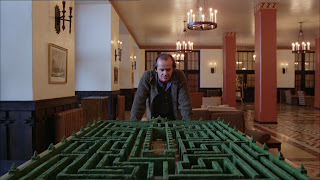
https://blogger.googleusercontent.com/img/b/R29vZ2xl/AVvXsEhL4PvgTCVB6VcWgej7uAC05sOJCsphHyoD0JAmihrqi6q3ANgOatvUDHgWRP7vJYJdwQ5_7vKmWw4wX6w32eqVTuIbmzJ05MbRbFF33L82-1JBe80wMzB0Sh4VEW3fSYOhI4qppdU3n7FO/s1600/shining_maze.jpgStep back and take stock of your life periodically.  In doing so, you might discover that you have taken a wrong turn or stayed too long on a short path.  Life doesn’t have GPS; a computerized voice doesn’t instruct us to decide this way or that and so we find ourselves lost sometimes.  Discovering our wrong turn and rectifying the mistake puts back in the right direction.

The Torrance family sought to find healing in the solace of the mountains.  Jack hoped to mend his relationship with his wife and son while beating his alcoholism - a reversal of his normal behavior.  He also hoped to find a novel.  So, as the winter settled in, he began to work.  And work.  And work.

During Samantha and my analysis of our own recent life, we discovered that we do not take enough individual time for ourselves.  We do other things than just work our businesses, but our lives fill up quickly with obligations to other people, other activities, and other organizations; we find ourselves scheduled to death by our own hand.

https://blogger.googleusercontent.com/img/b/R29vZ2xl/AVvXsEi6ZRJiqULQ4R61ORL7sT2lDMqPPx-LJ-KwewCxw8QXKrdhuDNl3Fohurd9KHy-HMh5nH6lzfSb1weW9LRvPDDMYc51KofErw5LimxsH19x7CNFxPBo-4jFlE_PoPHCeeptNCpPgTUinA4w/s1600/shin.jpg
Jack Torrance discovers this same problem the longer he spends pounding away at his typewriter.  The unfortunate consequence of taking a winter sojourn in a mildly haunted hotel and working nonstop?  As the movie says - all work and no play makes Jack a dull boy.  He goes crazy and attempts to kill his family.

While we may not be sequestered in a lonely haunted hotel, the message is the same for us as it was for Jack.  Left to our own overworked lives, without manifesting change, we would find ourselves heading down a similar slippery slope.  Death by axe is not a typical result, but don’t doubt that your relationships could end up broken and mangled, not to mention your own happiness.  Take stock and make sure you are not headed down the same path as Jack.  You might find yourself frozen out of happiness.

Sunday, February 3, 2013

Paralysis of Analysis


I have a student who probably should have made region band this year.  Honestly, there is no probably about it.  Had he guided his practice efforts the right way, he would have made region band.  Unfortunately, he succumbed to his insecurities in a way most of us would find familiar.  He couldn’t ever get out of his own head.

Probably three-quarters of the work my students need to do lies in personal perception and how that guides their practice and performance.  Fundamentally, most bassoon students, if placed correctly, are highly intelligent, strongly independent young people.  If prepared the correct way from the moment they first begin to learn their craft, they would all experience high levels of success.  Unfortunately, from the first time they touch the instrument, they experience instruction aimed primarily at correcting mistakes.    For many students, their early instruction teaches them to ferret out errors.  While this may seem like the best way to focus practice, these students have learned to do it to a fault.

The student I mentioned above suffers from this problem.  We can hardly make it through a measure or two before he stops to point out his errors.  He constantly stops, describing the mistake, reasoning out the origin of the error, before restarting.  Left to his own devices, we would never make it past the first line of anything in our lessons.  I am certain his practice sessions proceed the same way.  He is plagued with paralysis of analysis.

My job in his lessons is to deflect his focus from errors.  I work in small chunks of music; any time he stops, I instantly redirect - “keep playing, keep playing, keep playing” - until he resumes.  I don’t let him offer a single unobstructed comment until he has completed the chunk.  Once he achieves that, we dissect the phrase, find the errors, prescribe a solution, and work through it again - without stopping.  Slowly, I am teaching him to practice the right way.  He will make region next year.


Most of us succumb to the same sort of paralysis at points in our life.  We over-think to the point of negativity, sometimes thinking long past the point when decisions should be made.  Often, we wait so long, decision making slips from our skill set, leaving us bereft of the ability to even decide something as simple as what to eat.  

This paralysis resides in fear.  My student fears someone will catch him unaware of his own mistakes, so he stops constantly to point them out when playing on his own.  When playing in band class, the fear retreats - the likeliness of getting caught making mistakes reduces substantially when playing with sixty or seventy other musicians.  If we looked deep within ourselves, our insecurities develop from similar fears.  Our society prides itself on perfection.  We learn from an early age mistakes are frowned upon, so we prevent them by avoiding activities in which they occur or we jump the gun and point them all out unnecessarily.  Neither are the solution.

Makemisteaks_monsieurcabinet-480x679
I teach my students that mistakes lead to growth.  We are human; we err.  I tell them to give themselves permission to make mistakes.  Allowing themselves to err reduces the power a mistake has over their psyche.  Eventually, they roll right past their mistake unaffected.  Now, to be clear, I stress the difference between ignoring a mistake and moving past a mistake.  One is healthy, the other is not.  We practice with a “mistake basket” in which they deposit their mistakes while playing a particular passage.  After they complete the passage, we examine the basket’s contents and decide which items need our focus.  Eventually, we free ourselves from the paralysis of analysis.

Mistakes are necessary for growth, for developing character.  Learning how to handle mistakes in our lives positions us to roll with anything the world might throw our way.  Avoiding or over indulging them does not offer a solution to the problem, rather it roots the problem deeper.  Avoid the paralysis of analysis before it sets in too deep.

Sunday, January 27, 2013

To Be Fair . . .


In last week’s blog - Lancing the Boil - I lambasted Lance Armstrong for his lame apology during an interview with Oprah Winfrey.  While I still stand behind my original feelings - he never really apologized, and if he did, it was only to himself for getting caught - I have thought long and hard about the impact Lance has had on this planet.  To be fair . . . it isn’t all bad.

Lance is another athlete continuing the storyline that the only way to win is to cheat.  Enough sports superstars in the last decade have fallen from grace through doping scandals that it comes across as old hat now.  I don’t think anyone should find themselves shocked that athletes cheat.  We should only feel shock when it no longer comes across as wrong.

In 1997, before Lance Armstrong’s worldwide fame blossomed in the French Pyrenees, he fought a more dangerous battle than any before or after - testicular cancer.  His fight, the lessons he learned as he slugged it out with malignant cells, and the resulting Livestrong foundation, will sustain his positive legacy long after his unfair cycling victories fade from society’s collective mind.

The Livestrong Foundation, who recently cut all ties to the founder and former chairman, no longer contributes to cancer research as it once did (its funding was a drop in the bucket compared to cancer behemoths like American Cancer Society and the National Cancer Institute).  Instead, Livestrong focuses on changing the global perspective on cancer.  Due to Lance’s efforts through the Livestrong organization, cancer patients no longer endure the disease, they fight it.  Instead of cancer victims, cancer survivors emerge from their battle.  

Additionally, Livestrong focuses on guiding anyone fighting the disease to organizations that can offer preparation and assistance with the difficulties associated with life after cancer.  They offer direction on sperm banking and egg freezing to help with fertility, provide literature on clinical trials, distribute free cancer guidebooks, and connect people with organizations designed to help navigate the maze of healthcare finance.  

Livestrong has established an exercise program through the YMCA tailored specifically for cancer survivors.  Through Scholastic magazine, Livestrong at School teaches lessons to young students about cancer, ensuring from a young age that cancer no longer appears as a sure death sentence.  In 2009 Livestrong hosted the Global Cancer Summit in Dublin, Ireland aimed at removing false stigma associated with cancer in less developed portions of the world.

More locally, in 2007, Lance spearheaded the effort to pass Texas Proposition 15, creating the Cancer Prevention and Research Institute of Texas, funded with up to $3 billion in public money to research the causes of and cures of cancer.  Prop 15 would not have passed without the efforts of Lance Armstrong.

The most important effort, though is how Lance Armstrong changed the spirit of how the patient should approach cancer treatment.  Through Livestrong, he offered a different mindset, one of active healing rather than passive suffering; unlike cancer, this new mindset is contagious.  Would Livestrong have yielded such great results without Lance’s cycling success?  No.  But to me, that is besides to point; I have always been a believer that the universe uses everything for an eventual positive result, no matter how negative.  Ultimately, in the final analysis, Lance’s cheating is our gain, though it make take time for us to realize it.

Sunday, January 20, 2013

Lancing the Boil


This week, Lance Armstrong, cycling villain extraordinaire, took the first step towards healing the wounds caused by his extensive doping scandal.  Guided by one of the world’s most pre-eminent celebrity interviewers, Oprah Winfrey, Lance admitted to using nearly every imaginable type of banned performance enhancing substance.  He outlined    the steps he took to win, to “level the playing field,” as he put it.  The one thing that was missing?  A real apology.

A boil is typically a cyst or infected hair follicle gone bad.  The minor infection expands into a larger area of the body, increasing both in size and effect.  A severe boil can lead to more significant infection; even an average size one can cause severe fever and extreme weariness as the body fights.  The first step in treating the infection combines the repeated use of a heated compress with thorough washing.  Drawing the pus to the surface prepares it for the next step.

Lance needs to learn how to apologize.  He reminded me of the time I was caught drinking syrup from the bottle (that stuff tasted good!).  I apologized to my Mom, but I was more sorry to myself for getting caught than I was about drinking the syrup.  Lance’s delivery, his body language, even his word choices all contradicted the intended apologetic spirit of the interview.  Perhaps he felt sorry, but his demonstration of that feeling lacked merit, and to many, appeared equally as insulting.

When treating a boil, doctors will also prescribe antibiotics and topical creams to treat the infection.  Employing a multi-pronged attack helps to ensure a successful initial treatment.  Taking care to reach the infection from every angle prevents a relapse.

A true apology can be an art many of us find unfamiliar.  Our society raises up the strong, and to many, apologizing implies weakness.  This is backwards to me; admitting error takes incredible spiritual strength.  By cheating in the first place, Lance demonstrated his lack of internal strength.  Should anyone be surprised that his apology lacked strength as well?

Lancing a boil can be dangerous, and when used as the only means of treatment, often leads to re-infection or secondary infection.  When not approached in the proper way, the pus remains hard packed, continuing to clog the wound.  Not consulting a medical professional and taking the knife into our own hands often yields terrible results.  

Lance’s apology came across as a personal attempt to lance the boil of his years of lies, deceit, and outright despicable behavior.  The boil on Lance’s soul is filled from his mistreatment of friends and associates, his destructive attacks on people’s lives for attempting to expose the truth, and the incredible disservice he has done to his fans.  Because Lance did not treat his own infection before attempting to lance it, true healing is impossible.  Only after the right steps will Lance truly be able to move forward from this and heal along with everyone he has hurt.

- a good article on how to correctly apologize using Lance's apology as an instructive counterpoint

Sunday, January 13, 2013

The Paper Monster


While I know it is only January, and for the majority of the country W-2s won’t appear until early February, but tax time began in my house on January 1.  With both Samantha and I owning our own businesses, tax time is a time of extra work, hopefully ending in a positive result.  The best way to earn that positive result in the end?  Good planning.

I have planned well in the past, preparing files at the beginning of the year for receipts.  Then, through the year, I consolidated information periodically to prevent a huge load of work dumped on me at the end.  This year, I employed a slightly different method - the wait and get dumped on method.

While I am only a short time into the effort, I can tell you right now that the planning method is much better.  After a year of stuffing receipts into a drawer until they really couldn’t fit anymore, I figured I better start sorting them.  With Samantha’s help, we knocked out the sorting in an afternoon and evening.  Now comes the documenting.

It has taken me four days to get through the food receipts.  Just the food receipts.  I have sorted them into months, added the information into a spreadsheet, scanned the receipts, and thrown them away (which is allowed by the IRS).  Four days.  I could have probably spent thirty minutes one day a month on all my receipts, sorting, documenting, scanning, etc.  Instead, I waited until now.

I still have gas receipts, office supplies, music supplies, beauty care supplies (for Samantha’s Mary Kay business), utility payments, home mortgage interest, home maintenance expense receipts, health care, and a plethora of other receipts to document.  After that, I will need to document business travel and make decisions about the standard deduction offered by the IRS for travel versus the actual costs.  Then I have . . .  needless to say, the list is expansive.

I will be the first to admit my lack of a plan for the past year’s taxes was first the result of laziness.  I just never got around to it.  Later, though, I didn’t want to battle the monster I had created.  The pile of receipts had just grown too large to handle, so I ignored it.

With solid pre-planning, I could have been wrapping up my yearly taxes over the last four days.  Instead, I am embarking on a journey as long and drawn out as the first Hobbit movie, while not being nearly as exciting.

The tax benefits of owning two businesses are great; nearly everything we do is tax deductible.  Successful planning is key, though.  

As always, I extrapolate my experiences into life lessons.  I think this one is fairly obvious, and I can see where, if employed properly in other areas of my life, it will yield better results.  Planning is important.  Sure, flying by the seat of your pants can be exciting, too, but it definitely isn’t the way to run your entire life.