What’s in it for me? I have asked that question before; I imagine many of us have. We often look for the personal benefit in our lives, maneuvering ourselves into positions of gain. After all, we are capitalists. Our society functions on risk vs. reward, on pain and gain, on me-first principals.
Are these principals our best option? Paradoxical commandment number four suggests a better one:
The good you do today will be forgotten tomorrow. Do good anyway.
Living in a society where investment pays off in future dividends, the concept of doing good for good’s sake might seem alien. Often, even when we don’t ask the question externally, silently, “what’s in it for me” haunts the back of our minds. Should I help out because people will see me helping? Should I do this because someone will owe me a favor? Should I do this to add it to my resume?
Why not do good for goodness sake?
Unfortunately, the modern battle between atheist and theists have hijacked this particular discussion. Somehow, the two sides believe they have immanent domain over goodness (this does not include all atheists or theists). The atheist argues that goodness is enough - God becomes unnecessary. The theist argues that doing good enacts the love of Jesus Christ in the world.
Personally, I don’t believe doing good belongs to either camp exclusively. Where you stand dictates your feelings. The commandment negates the reason for even having an argument in the first place. Do good. That is enough.
We should do good absent a reason. Our actions should seek to create good simply for it to exist. C.S. Lewis sums up our fourth commandment perfectly:
Integrity is doing the right thing, even when no one is watching.
I think the commandment speaks to the longevity of the effects as well. Even as the results of your good act vanish, the goodness itself does not. As another famous man suggests, leave tomorrow for tomorrow. Do good now. Don't worry about anything else.
-
I first encountered an adapted version of the “Paradoxical
Commandments,” titled “The Final Analysis,” while listening to a Wayne
Dyer audio CD in my early twenties. The meaning and message struck me
as true, helping guide my thoughts and actions as I developed from a big
kid into a real adult. Later, I discovered the poem was not actually
written by Mother Theresa at all, but adapted, framed, and hung on the
wall in her Calcutta orphanage. She cared about its message enough to
use it to empower the weak and marginalized children to whom she gave
her life.
The Paradoxical Commandments are reprinted with permission. © Copyright Kent M. Keith 1968, renewed 2001
People often assume the worst of others. We judge too quickly, assigning motive to actions with little to no information. Then, when true facts arrive, the unfortunate strength contained within first impressions cements our original impressions despite evidence to the contrary. Conversely, the same actions affect other people’s view towards us.
Dr. Kent M. Keith’s second Paradoxical Commandment stands to battle the reality of the above paragraph.
If you do good, people will accuse you of selfish ulterior motives. Do good anyway.
The definition of “good” fluctuates based on perspective. What I perceive as good may not be the same as you. People with shared cultural values tend to believe in similar “good,” but not always. Just take a look at the political landscape of the last few years. Though Republicans and Democrats claim to work towards the highest good for our country, they quickly decry anything the other party presents as “good” for the country, accusing each other of selfish and ulterior motives.
The same can be seen on platforms as immense as the geopolitical landscape or as tiny as inter-office politics. The human inclination towards distrust clouds our judgement. Dr. Keith suggests ignoring negative opinion, or at the very least acknowledging and summarily dismissing its existence, continuing with actions in which we find inherent goodness.
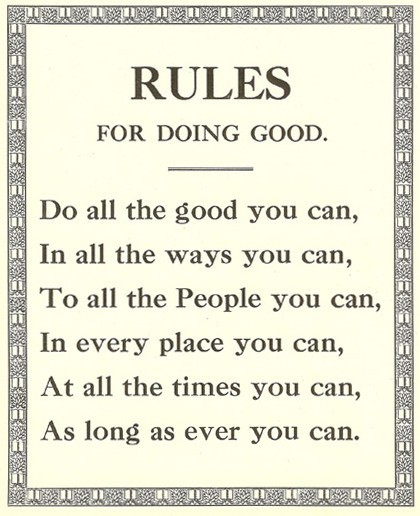 I believe in the contagion of good actions. Good breeds good. One good turn deserves another. Pay it forward. No matter the collection of words, the intent and meaning carries truth and power. Despite how others may view your actions, and no matter the size, the inherent truth and goodness contained within infects others. Soon, through consistent good action, your life changes. You become contagious. You infect others. Goodness spreads. The disease others decried as self-serving becomes the norm instead of the oddity.
Remember, it is none of your business what other people think about you. All it takes is one action to kickstart it all.
-
I first encountered an adapted version of the “Paradoxical
Commandments,” titled “The Final Analysis,” while listening to a Wayne
Dyer audio CD in my early twenties. The meaning and message struck me
as true, helping guide my thoughts and actions as I developed from a big
kid into a real adult. Later, I discovered the poem was not actually
written by Mother Theresa at all, but adapted, framed, and hung on the
wall in her Calcutta orphanage. She cared about its message enough to
use it to empower the weak and marginalized children to whom she gave
her life.
The Paradoxical Commandments are reprinted with permission. © Copyright Kent M. Keith 1968, renewed 2001


