 The summary message contained in the Dr. Kent M. Keith’s Paradoxical Commandments resonates with an appropriate measure of cynical optimism. In some ways, it seems as if he implores us to do our best while expecting the worst. After only a surface reading, I would agree, but when taken as a whole, the commandments reveal a deeper truth rooted solely in optimism. Paradoxical Commandment number ten continues in the same vein:
Give the world the best you have and you’ll get kicked in the teeth. Give the world the best you have anyway.
Dr. Keith’s commandments seek to weaken pessimistic arguments against them by including the very arguments in the commandments. This best of/worst of pairing creates the paradoxical nature the commandments embody. Dr. Keith acknowledges humanity’s own tendency towards the negative, the trend we feel to pull others down, and he tells us not to worry about it. Our own nature combats this very same paradox on a daily basis.
Imagine the commandments without the negatives:
- Love
- Do good
- Succeed
- Do good
- Be Honest and Frank
- Think big
- Fight for the underdogs
- Build
- Help People
- Give the world your best
Without the negatives, the commandments ignore our own nature, losing much of their power to connect with us. We know these are actions we should take, but our weak egos immediately throw up defensive fortifications based on previous experience:
- People are illogical, unreasonable, and self-centered
- People will accuse you of selfish ulterior motives
- You will win false friends and true enemies
- Good is forgotten quickly
- You will be vulnerable
- Small men and women with small minds will shoot you down
- People only follow top dogs
- What you build will be destroyed
- People may attack you
- You will get kicked in the teeth.
These are our ego’s defenses. By splashing them on the page paired with our desired attributes, we eviscerate the ego’s defense. We know these are all possibilities, but we don’t care. We give the world our best anyway.
As your daily life unfolds in front of you, ignore the negative possibilities swirling around your every action. Focus instead on the power of your good, on the vast love you hold for your fellow man, and on the possibility of success in your life.
You are strong and you are powerful. No matter what the world throws at you, be and do your best. Do it anyway.
-
I first encountered an adapted version of the “Paradoxical
Commandments,” titled “The Final Analysis,” while listening to a Wayne
Dyer audio CD in my early twenties. The meaning and message struck me
as true, helping guide my thoughts and actions as I developed from a big
kid into a real adult. Later, I discovered the poem was not actually
written by Mother Theresa at all, but adapted, framed, and hung on the
wall in her Calcutta orphanage. She cared about its message enough to
use it to empower the weak and marginalized children to whom she gave
her life.
The Paradoxical Commandments are reprinted with permission. © Copyright Kent M. Keith 1968, renewed 2001
People often assume the worst of others. We judge too quickly, assigning motive to actions with little to no information. Then, when true facts arrive, the unfortunate strength contained within first impressions cements our original impressions despite evidence to the contrary. Conversely, the same actions affect other people’s view towards us.
Dr. Kent M. Keith’s second Paradoxical Commandment stands to battle the reality of the above paragraph.
If you do good, people will accuse you of selfish ulterior motives. Do good anyway.
The definition of “good” fluctuates based on perspective. What I perceive as good may not be the same as you. People with shared cultural values tend to believe in similar “good,” but not always. Just take a look at the political landscape of the last few years. Though Republicans and Democrats claim to work towards the highest good for our country, they quickly decry anything the other party presents as “good” for the country, accusing each other of selfish and ulterior motives.
The same can be seen on platforms as immense as the geopolitical landscape or as tiny as inter-office politics. The human inclination towards distrust clouds our judgement. Dr. Keith suggests ignoring negative opinion, or at the very least acknowledging and summarily dismissing its existence, continuing with actions in which we find inherent goodness.
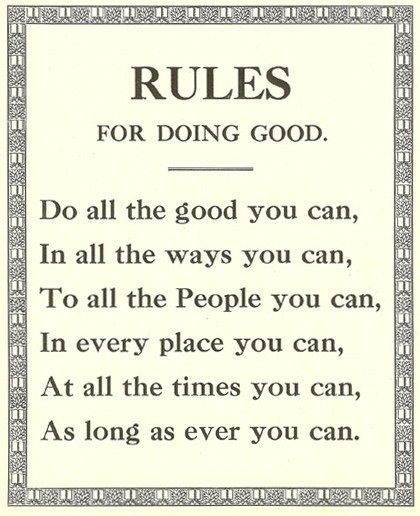 I believe in the contagion of good actions. Good breeds good. One good turn deserves another. Pay it forward. No matter the collection of words, the intent and meaning carries truth and power. Despite how others may view your actions, and no matter the size, the inherent truth and goodness contained within infects others. Soon, through consistent good action, your life changes. You become contagious. You infect others. Goodness spreads. The disease others decried as self-serving becomes the norm instead of the oddity.
Remember, it is none of your business what other people think about you. All it takes is one action to kickstart it all.
-
I first encountered an adapted version of the “Paradoxical
Commandments,” titled “The Final Analysis,” while listening to a Wayne
Dyer audio CD in my early twenties. The meaning and message struck me
as true, helping guide my thoughts and actions as I developed from a big
kid into a real adult. Later, I discovered the poem was not actually
written by Mother Theresa at all, but adapted, framed, and hung on the
wall in her Calcutta orphanage. She cared about its message enough to
use it to empower the weak and marginalized children to whom she gave
her life.
The Paradoxical Commandments are reprinted with permission. © Copyright Kent M. Keith 1968, renewed 2001